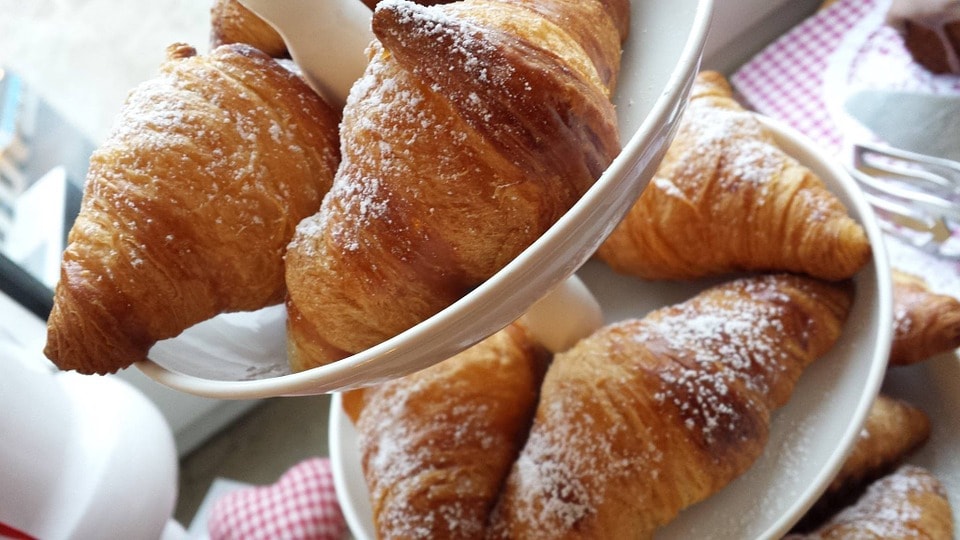
Laminated Doughs
Laminated doughs are a light and flaky pastry made of a piece of fat (traditionally butter) that is wrapped with basic dough, which is then folded and sheeted several times to obtain a multi-layered dough. To date, no global uniform standard exists for the preparation of puff pastry or related products. For instance, in the German literature, the French method describes that a piece of dough is wrapped in fat. The Dutch or Scottish method describes a rapid preparation of puff pastry with lower volume and quality. The cold fat is cut into cubes which are added and mixed with the basic dough before the lamination, which results in discontinuous layers. However, with combinations of different, repeated folding steps, products with numerous layers, usually from 48 to 256, can be obtained. Typically, these multi-layered doughs have a relatively high amount of fat (20%–35% on total mass).
Primarily, high costs and the difficult handling of the traditionally used butter during industrial processing initiated the development of specifically manufactured fat blends. These fat blends are derived mainly from vegetable oils and fats, offering a better process ability (fat plasticity). Thus, nowadays, they are preferred for commercial puff pastry production. Nevertheless, artisanal bakeries still prefer butter.
Unlike other laminated baked goods such as croissants and Danish pastry that have the additional leavening from yeast, puff pastry is made of unleavened dough. The functional roles of fat in puff pastry and other products of this making are to separate the many thin dough layers from each other and, after melting, to protect the starch granules from gelatinization. During the baking process, the water located in the dough vaporizes and generates steam which expands but cannot pass the coagulated gluten network within the dough layers. This expansion of steam between the dough layers causes the rise of the puff pastry. In addition, fat is essential as a flavor carrier and gives the final product its specific characteristics, such as a good structure, texture and mouth feel.