The Understanding of Ingredients: Fats & Oils
Fats and oils are organic compounds that, like carbohydrates, are composed of the elements carbon (C), hydrogen (H), and oxygen (O), arranged to form molecules. They provide 9 kcal per gram. All fats become oils and vice versa, depending on temperature. Physically, fats consist of minute solid fat particles enclosing a microscopic liquid oil fraction. The consistency of fat is very important to the baker. It is very difficult to work with butter (relatively low melting point) in hot weather. At the other extreme, fats with a very high melting point are not very palatable, since they tend to stick to the palate. Fat manufacturers have therefore attempted to customize fats to accommodate the various needs of the baker. Fats with a melting range between 104°F and 112°F (40°C and 44°C) are considered a good compromise between convenience in handling and palatability.
- “Rancid” is a term used to indicate that fat has spoiled. The fat takes on an unpleasant flavor when exposed to air and heat. Unsalted butter, for example, will go rancid quickly if left outside the refrigerator, especially in warm climates.
- Oxidation (exposure to air) causes rancidity in fats over time. This is made worse by combination with certain metals, such as copper.
- Some oils contain natural antioxidants, such as tocopherols (vitamin E is one kind), but these are often destroyed during processing.
- Manufacturers add synthetic antioxidants to retard rancidity. BHA and BHT are synthetic antioxidants commonly used by fat manufacturers.
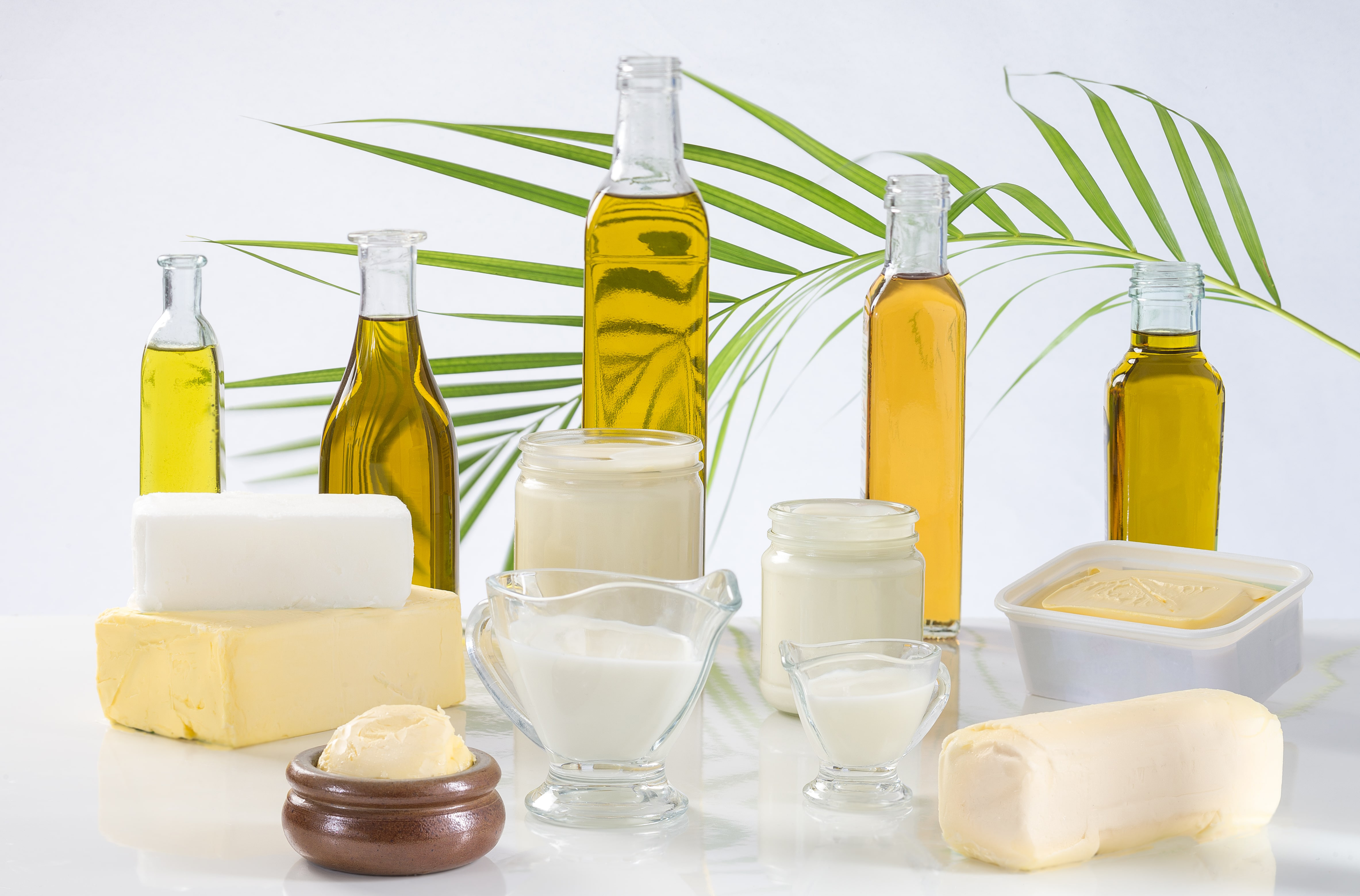
Saturated Fats
Saturated fat is a type of fat found in food. The general assumption is that the less saturated fat the better as far as health is concerned. For the fat manufacturer, however, low saturated fat levels make it difficult to produce oils that will stand up to the high temperatures necessary for processes such as deep-frying. Saturated fat is found in many foods:
- Animal foods (like beef, chicken, lamb, pork, and veal)
- Coconut
- Palm and palm kernel oils
- Dairy products (like butter, cheese, and whole milk)
- Lard
- Shortening
Unsaturated Fats
Unsaturated fat is also in the foods you eat. Unsaturated fat is a source of omega-3 and omega-6 fatty acids, generally referred to as “healthy” fats. Even though unsaturated fat is a “good fat,” having too much in your diet may lead to having too many calories, which can increase your risk of developing obesity, type 2 diabetes, heart disease, and certain types of cancer.
Two Types of Unsaturated Fats
- Monounsaturated fats are found in a variety of foods, including in the following:
- Avocados
- Mayonnaise and oil-based salad dressings
- Nuts (such as almonds, hazelnuts, peanuts, and pecans)
- Olives
- Seeds (such as pumpkin and sesame seeds)
- Soft margarine (liquid, spray, and tub)
- Vegetable oils (such as canola, olive, peanut, and safflower oils)
- Polyunsaturated fats are found in a variety of foods, including in the following:
- Fish (such as herring, mackerel, salmon, trout, and tuna)
- Mayonnaise and oil-based salad dressings
- Nuts (such as pine nuts and walnuts)
- Seeds (such as flax, pumpkin, sesame, and sunflower seeds)
- Soft margarine (liquid, spray, and tub)
- Vegetable oils (such as corn, cottonseed, soybean, and sunflower oils)
Hydrogenation
Hydrogenation is the process of adding hydrogen gas to alter the melting point of the oil or fat. The injected hydrogen bonds with the available carbon, which changes liquid oil into solid fat. This is practical, in that it makes fats versatile.
Think of the different temperature conditions within a bakery during which fat must be workable.
Trans Fat
Trans-fat is made from a chemical process known as “partial hydrogenation.” This is when liquid oil is made into a solid fat. Like saturated fat, trans-fat has been shown to raise LDL or “bad” cholesterol levels, which may in turn increase your risk for heart disease. Unlike saturated fat, trans-fat also lowers HDL or “good” cholesterol. A low level of HDL-cholesterol is also a risk factor for heart disease. Until recently, most of the trans-fat found in a typical American diet came from:
- Fried foods (like doughnuts)
- Baked goods including cakes, pie crusts, biscuits, frozen pizza, cookies, and crackers
- Margarine and other spreads
Emulsification (Emulsified Shortenings)
Emulsification is the process by which normally unmixable ingredients (such as oil and water) combined into a stable substance. There are natural emulsifiers such as lecithin, found in egg yolks. Emulsifiers are added to many hydrogenated fats, improving the fat’s ability to do the following:
- Develop a uniformly fine structure
- Absorb a high percentage of sugar
- Hold in suspension a high percentage of liquid
Emulsified shortenings are ideal for cakes and icings, but not suitable for deep-frying.
Stability
The ability of a shortening to have an extended shelf life refers especially to deep-frying fats, where a smoke point of 428°F to 446°F (220°C to 230°C) indicates a fat of high stability. The smoke point is the temperature reached when fat first starts to smoke. The smoke point will decline over time as the fat breaks down.
Fat Breakdown (hydrolysis) is the chemical reaction of a substance with water. The moisture, which is at the root of this problem, comes from the fried product. This is why it is a good idea to turn off the fryer or turn it to “standby” between batches of frying foods such as doughnuts. Fatty acids separate from their glycerol molecules and accumulate over time in the fat. When their concentration reaches a certain point, the fat takes on an unpleasant taste. Another cause of fat breakdown is excessive flour on the product or particles breaking off the product.